When Allina Health launched its Hello4Health program, the goal was clear: Provide digital tools that help adults build social connections and combat loneliness.
The populations most affected by social isolation include two sizeable demographics—people with disabilities and older adults. Because these populations are also more likely to experience barriers when they’re navigating a website, accessibility quickly became a critical requirement for the program’s website.
To ensure the Hello4Health website could truly serve everyone in its community, Allina Health partnered with full-service marketing and development agency Trilix for design and development, and Allyant for accessibility expertise and accessibility management software. Together, the teams implemented a structured accessibility workflow that includes regular auditing, prioritized remediation, and ongoing monitoring to ensure Hello4Heath remains accessible for all.
Highlights
Objective: Ensure the Hello4Health website could serve 100% of Allina Health’s community, despite limited internal accessibility expertise.
Solution: Partnered with Allyant to audit the Hello4Health website and Trilix to prioritize accessibility remediation, together, establishing an ongoing accessibility governance process.
Allyant Products Used: Allyant’s Platform with issue identification, severity classification for prioritization, and code-level remediation guidance; manual testing, including testing by users with disabilities; expert support.
Results: Accessible Hello4Health website aligned with WCAG standards to ensure access for all, with repeatable audit and structured remediation workflows established to maintain conformance.
Impact: Fully accessible website supporting patients and community, strengthening trust without sacrificing functionality or design.
If we’re building resources to reduce loneliness but those resources aren’t accessible, we’re excluding the very people who may need them most.”
Christy Dechaine, System Manager, Community Health and Measurement, Allina Health
Objective
Allina Health’s community health improvement programs focus on addressing real-world needs identified through community health assessments. One key concern is social isolation and loneliness, particularly prevalent among people with disabilities and older adults.
Hello4Health was created to provide tools, education, and resources to help adults build meaningful social connections. Because the program and its resources are delivered through a digital platform, ensuring the website could be accessed by everyone—including individuals with visual, auditory, or mobility impairments—was essential.
“People with disabilities represent one of the largest communities in our society—and one many of us will join as we age,” said Christy Dechaine, System Manager, Community Health and Measurement at Allina Health. “If we’re building resources to reduce loneliness but those resources aren’t accessible, we’re excluding the very people who may need them most.”
To ensure users with disabilities can interact with digital content, a website must be designed and developed following the web content accessibility guidelines (WCAG). These guidelines ensure—for example—users reliant upon assistive technology can properly interact with a website, users who have limited mobility can engage with content using a keyboard versus a mouse, users who are colorblind are not reliant upon color to understand information. Ensuring every visitor could interact with the resources they needed was a non-negotiable.
“When someone is referred to a support resource, it’s often because they’re already struggling,” explained Sydney Hobart, Community Health Improvement Program Design Consultant at Allina Health. “The last thing we want is for them to experience a barrier we’ve created, which can deepen the sense of isolation we’re working hard to help prevent.”
Solution
To achieve its accessibility goals, Allina Health knew it needed external expertise. It partnered with full-service marketing agency, Trilix, to design and develop the Hello4Health website, and accessibility solution provider, Allyant, to provide accessibility testing, auditing, remediation guidance, and support.
“Accessibility requires deep technical expertise,” said Hobart. “Partnering with Allyant provided the tools and support the Trilix development team needed to create an accessible digital experience, allowing us to keep our focus on supporting the health of our community.”
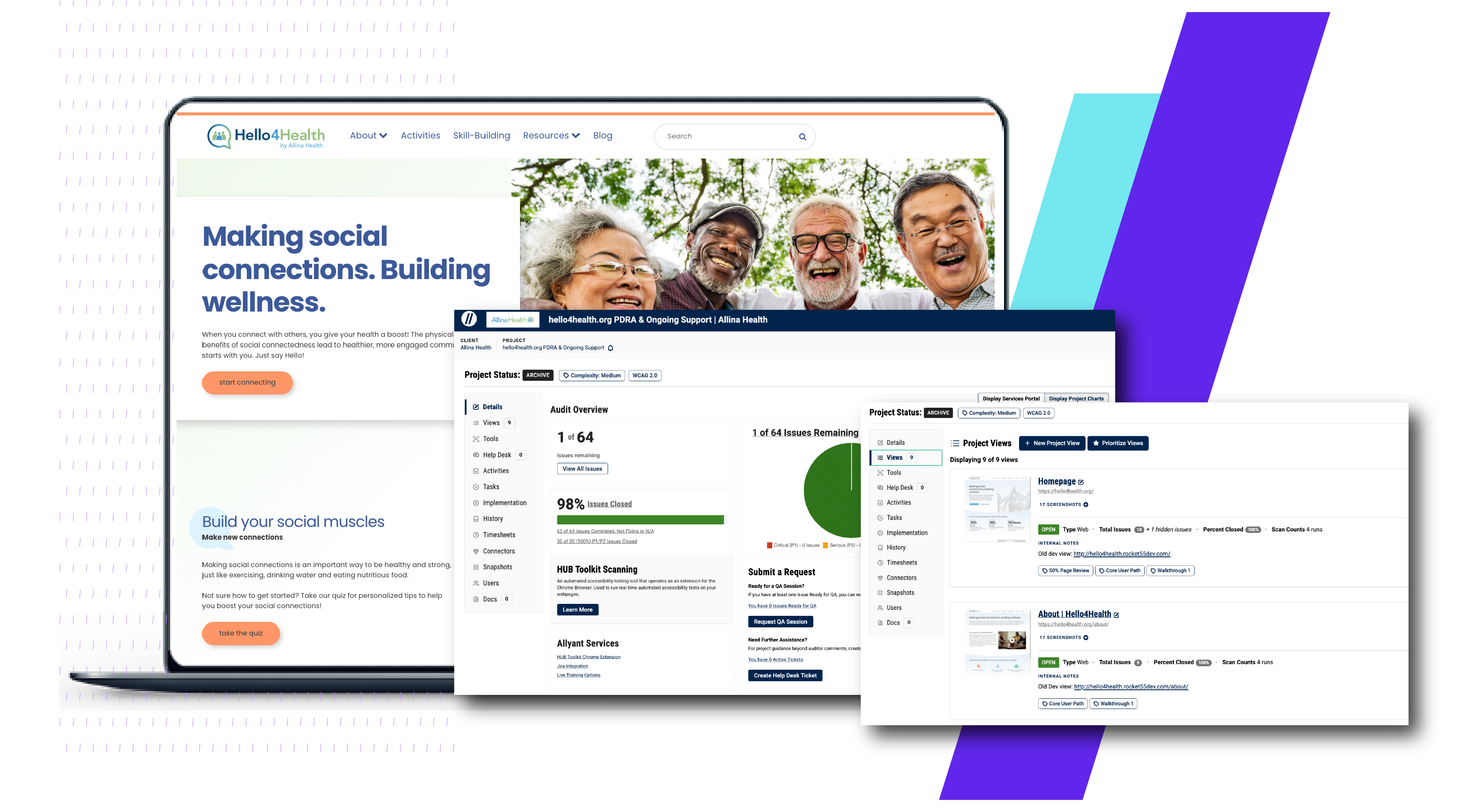
Accessibility work started with an audit, leveraging Allyant’s automated and manual testing—including testing conducted by users with disabilities. And with audit results delivered via Allyant’s accessibility management platform, the Trilix development team was able to easily review and prioritize issues based on criticality, update the website’s code to meet WCAG standards, and submit those updates for Allyant’s review and validation.
“When we first began, there was some uncertainty about what the process would involve,” said Jenny Peters, Senior Project Manager at Trilix. “But once our team started working in Allyant’s platform, errors and recommendations were clear and intuitive. Accessibility issues were well prioritized, and remediation was manageable thanks to the code-level guidance and access to the support Allyant provides.”
“What stood out to us about Allyant’s approach was the importance of users with disabilities testing our site,” said Ellie Henderscheid, Manager of System Community Engagement and Impact at Allina Health. “Meeting technical accessibility standards is important, but having people who actually rely on assistive technologies validate the experience gave us confidence that the site will work for everyone in the community we serve.”
Once our team started working in Allyant’s platform, errors and recommendations were clear and intuitive. Accessibility issues were well prioritized, and remediation was manageable thanks to the code-level guidance and access to the support Allyant provides.”
With audits scheduled every six to eight months, and structured remediation workflows established between Allina Health, Allyant, and Trilix, accessibility remains a central focus as site content evolves.
“And importantly, accessibility wasn’t a trade-off. We’ve never had to sacrifice functional quality or a warm and welcoming design to meet accessibility standards,” said Dechaine.
By recognizing its strengths and limitations, and aligning with the most effective, knowledgeable partners, Allina Health has built a sustainable model for delivering inclusive digital health resources—supporting its mission to serve 100% of its community.
Meeting technical accessibility standards is important but having people who actually rely on assistive technologies validate the experience gave us confidence that the site will work for everyone in the community we serve.”
Ellie Henderscheid, Manager of System Community Engagement and Impact, Allina Health
Learn how Allina Health implemented a structured accessibility workflow that includes regular auditing, prioritized remediation, and ongoing monitoring to ensure Hello4Heath remains accessible for all.
Join us for a live conversation with Shopify Platinum digital agency Vaan Group as we explore how they successfully embed accessibility into their client strategy.
We've measured the state of PDF accessibility. Now we discuss what it means—and how organizations can use these insights to build smarter, more sustainable accessibility programs.
Featuring the Colorado Governor's Office of Information Technology, we discuss high-impact initiatives to take to comply with ADA Title II before the April deadline.
Our inaugural PDF Accessibility Index captures the market's state of PDF accessibility, enabling you to benchmark your program against industry standards.
Join us for a live webinar where we’ll discuss the latest regulatory requirements, how to properly evaluate your vendor’s VPAT, and our six-step framework for ongoing success.
What is ACA Compliance? The Accessible Canada Act (ACA) is Canada’s federal accessibility law, designed to create a Canada without barriers by 2040. The ACA became…
Learn why accessibility is critically important. In this webinar, we demonstrate accessible websites and PDFs from the perspective of a blind screen reader user.